Secrets Of Mosfet Cross Reference and Replacement Guide
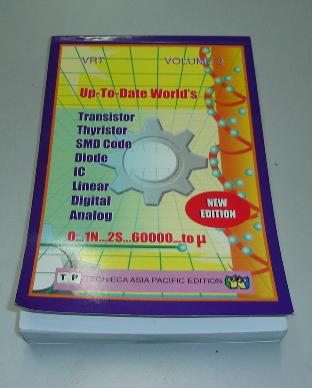
A Semiconductor Replacement Guide Searching for the right mosfet cross reference or datasheet, one has to look for a semiconductor transistor replacement data book and not the Philip ECG master replacement guide. Almost all the transistor replacement book will published out the specification of a particular components such as type of component it belong whether it is a fet, scr, bipolar transistor, horizontal output transistor and also the voltage, ampere, wattage, ohm, frequency and suggested substitution part number. From my experienced, the substitution part number that was recommended by the data book is not always 100 % match. If you have the time, I would like to suggest to you that, find the right part number by yourself rather than depending on the transistor data book.
It is the same when you look for horizontal output transistor (HOT) specification which doesn't mean that the bigger specification, the better the substitution part number is. In searching for Mosfet cross reference, you have to look at the ohms value which is provided by the transistor data book besides the specification of voltage, ampere and the wattage. The replacement, besides the same or higher in voltage, ampere and wattage, one should also consider the ohms value. The ohms value has to be as close as possible.
Arrow is showing the mosfet ohms value in a transistor substituion book If the original fet part number is 1 ohm then a good replacement mosfet must have the ohm values between of 0.5 to 1.5 ohm. Do not substitute it with a too high or too low ohms value as this will make the mosfet run warmer and eventually blow the mosfet itself. Even though you can get a replacement with a higher voltage, ampere and wattage, if the ohms value is too low or too high, the mosfet will still burnt after on for quite a while.
It runs well for sometimes before it breakdown again. After two weeks the customer brought back the printer with the same complaint which is no power. Upon checking the power side I found the same mosfet gave up again. Substituting with another mosfet part number that have a similar specification especially the ohms value solved the printer no power symptom. Specification with larger voltage, ampere and wattage don’t guarantee that the replacement mosfet will work. So, taking the mosfet ohms value into consideration, you will have a higher chances to repaired the equipment and sometimes the replacement mosfet will also last longer. |

Brazzersexxtra - Brazzers House 2 Unseen Moments |best| -
Smaller studios often drive cultural trends and win critical acclaim.
Historically, the studio system was defined by industrial efficiency. The “Golden Age” of Hollywood, dominated by MGM, Warner Bros., and Paramount, operated on a factory model. Studios owned the soundstages, employed the actors under long-term contracts, and controlled the distribution pipelines. A production like The Wizard of Oz (1939) was not merely a film; it was a product of MGM’s vertical integration, designed to maximize profit across theaters, merchandise, and star power. However, this efficiency came with a rigid gatekeeping function. The studios, governed by the conservative Hays Code, dictated what could be shown, whose stories were worth telling, and who could tell them. For decades, the popular imagination was filtered through a narrow lens—predominantly white, heterosexual, and American—not because other stories didn’t exist, but because the studios’ economic calculus deemed them unprofitable.
serves as an auxiliary label within the Brazzers ecosystem, typically reserved for special releases, compilations, and behind-the-scenes content that doesn't fit neatly into the main network's regular schedule. The label is known for offering fans extended cuts, alternative angles, and material that showcases the production process itself.
The Lord of the Rings: The Rings of Power , The James Bond franchise, and The Boys . Apple Studios BrazzersExxtra - Brazzers House 2 Unseen Moments
: Notable for its genre diversity, Sony Pictures Animation , and its major ownership of Columbia Pictures .
Disney is arguably the most dominant force in entertainment today. Beyond its own storied animation studio, Disney’s strategic acquisitions have turned it into an unstoppable conglomerate. By bringing , Lucasfilm , and Pixar under its umbrella, Disney controls the most lucrative intellectual properties (IP) in history—from the Avengers and Star Wars to Toy Story. Warner Bros. Discovery
In recent years, Sony has disrupted the visual language of the genre with the Spider-Verse series, blending street art aesthetics with comic book heritage to redefine what modern animation looks like. Why These Studios Matter Smaller studios often drive cultural trends and win
To help tailor more insights, could you specify if you need details on , a deep dive into gaming studios , or information on international production hubs like Bollywood or Nollywood?
Crucially, the last decade has witnessed a significant shift in who controls the narrative. The rise of streaming services like Netflix, Apple TV+, and Amazon Studios has disrupted the traditional gatekeeping model. Where theatrical studios once relied on a few blockbuster weekends a year, streaming platforms require a constant churn of content to keep subscribers engaged. This economic pressure has inadvertently opened doors for previously marginalized voices. Productions like Roma (Netflix), CODA (Apple TV+), and Pachinko (Apple TV+) would have struggled to find financing in the traditional studio system, deemed too “niche” for a wide theatrical release. Furthermore, the global reach of streaming has forced studios to move beyond Western-centric storytelling. The phenomenal global success of South Korea’s Squid Game (produced for Netflix) or France’s Lupin demonstrates that popular entertainment is no longer a one-way export from Hollywood but a global conversation. Studios are now discovering that authenticity—a Korean story told by Korean filmmakers—has greater universal appeal than a homogenized, Americanized remake.
The Fast & Furious franchise, the Jurassic World series, the Despicable Me/Minions universe, and Christopher Nolan’s historical epics. Studios owned the soundstages, employed the actors under
The global entertainment landscape is undergoing a massive transformation. The traditional Hollywood studio system, once defined by a few physical backlots in Los Angeles, has evolved into a complex ecosystem of legacy media giants, tech-driven streaming empires, and specialized independent powerhouses. Today, the most popular entertainment studios and productions are not just creating content; they are building massive multimedia franchises, leveraging cutting-edge technology, and dictating global cultural conversations. The Legacy Giants: Redefining the Traditional Studio System
In conclusion, popular entertainment studios and productions play a vital role in shaping the way we consume and interact with media. From film and television to music and video games, these studios and productions have been instrumental in creating content that captivates audiences worldwide. As the entertainment industry continues to evolve, it will be interesting to see how these studios and productions adapt to new technologies and changing audience preferences.
Copyright@ 2006-2014-www.ElectronicRepairGuide.com All Rights Reserved